Long before modern crash laboratories, airbags, and computer simulations became standard, automakers relied on bold real-world experiments to improve vehicle durability. A remarkable 1932 Studebaker safety film reveals just how far engineers were willing to go, making it one of the most fascinating chapters in automotive history.
Studebaker’s 1932 Safety Tests Were Unlike Anything We See Today
Modern crash testing is carefully controlled inside advanced laboratories using sophisticated sensors, high-speed cameras, and crash-test dummies. However, things looked very different almost a century ago.
Back in 1932, Studebaker engineers relied on practical demonstrations instead of computerized simulations. One of the most remarkable examples comes from a historical film titled Studebaker Safety, produced by the Chicago Daily News. The video showcases several dramatic experiments that tested the durability of the company’s vehicles under real-world conditions.
Even today, these tests remain surprisingly entertaining while also highlighting how automotive safety engineering evolved over time.
Rolling a Brand-New Car Down a Steep Hill
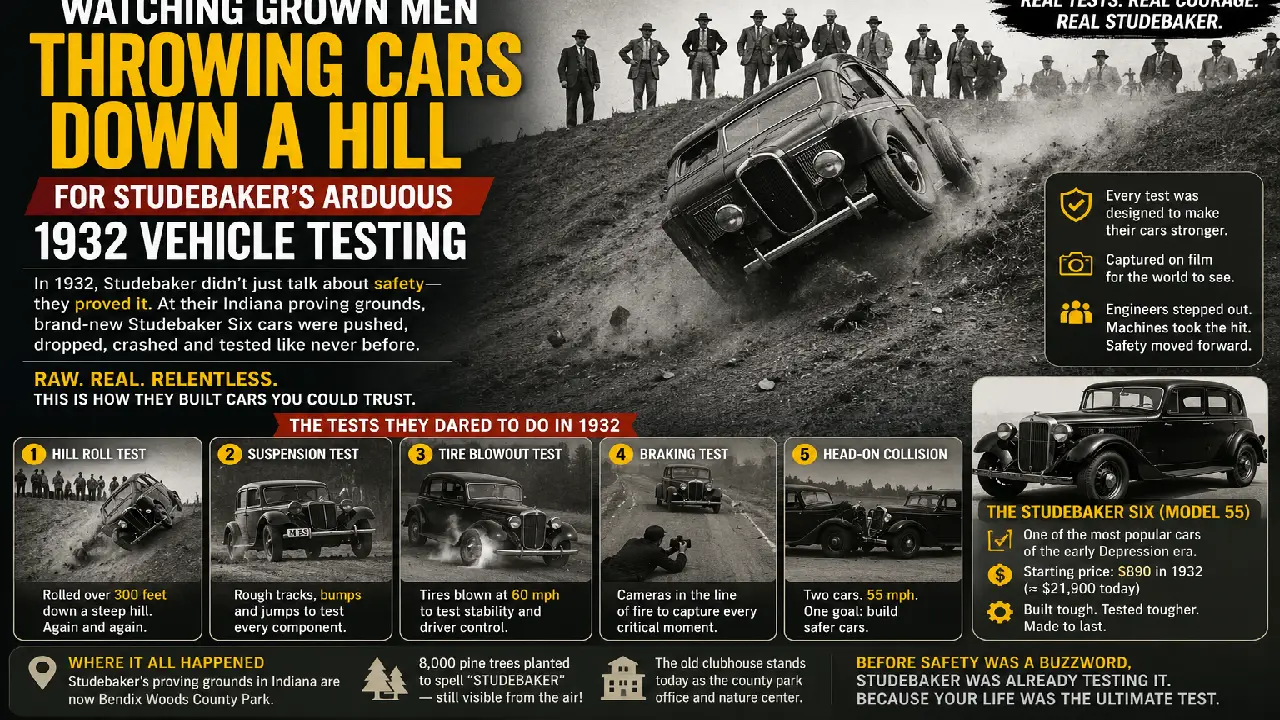
The film begins with what appears to be a factory-fresh Studebaker Six, also known as the Model 55. Instead of gently driving it around a test track, engineers positioned the sedan on its side using wooden supports and ropes before sending it tumbling hundreds of feet down a steep hillside.
The objective wasn’t simply to destroy the vehicle. Instead, engineers wanted to observe how the chassis, suspension, body structure, and mechanical components reacted after experiencing repeated impacts.
Although the method seems crude by today’s standards, it demonstrated the company’s commitment to understanding vehicle strength through practical testing.
Vehicle Durability Was Tested in Multiple Ways
The hillside experiment represented only one part of Studebaker’s extensive testing program.
Engineers also pushed the car across rough suspension courses designed to simulate extremely damaged roads. Slow-motion footage revealed all four wheels leaving the ground during certain sections, providing valuable insight into suspension movement and structural flexibility.
Moreover, another remarkable experiment intentionally burst the tires while the vehicle travelled at nearly 60 mph. Engineers carefully observed how the sedan behaved after suddenly losing tire pressure, helping them evaluate steering stability and driver control during emergencies.
| Test | Purpose |
|---|---|
| Hill Roll Test | Measure body strength and structural durability |
| Suspension Course | Evaluate suspension and chassis performance |
| Tire Blowout Test | Check stability after sudden tire failure |
| Head-on Collision | Study crash damage and passenger safety |
The Dramatic Head-On Crash Was the Film’s Biggest Highlight
The most memorable sequence arrives near the end of the film, where Studebaker engineers stage a full-speed head-on collision. Two identical Studebaker Six sedans accelerate toward each other before crashing at approximately 55 mph. Before impact, the engineers carefully exit both vehicles, allowing the cars to continue on their own. Even by today’s standards, the footage remains fascinating because it captures one of the earliest documented automotive crash demonstrations.
Surprisingly, the damage isn’t as catastrophic as many viewers might expect. While the front ends suffer extensive destruction, the vehicles display impressive structural integrity for their era. Earlier tests show that the Studebaker Six often continued driving after severe punishment, proving the strength of its engineering. Only the final collision leaves the cars completely disabled.
How Vehicle Testing Has Changed Since 1932
Automotive safety has evolved dramatically over the last nine decades. Today’s manufacturers rely on computer simulations, crash-test dummies packed with sensors, robotic driving systems, and high-speed cameras capable of recording thousands of frames per second. Every impact generates detailed information that helps engineers improve passenger protection.
However, the Studebaker film reminds us that modern testing methods were built upon decades of experimentation. Manufacturers during the early twentieth century often depended on practical demonstrations because sophisticated laboratory equipment simply did not exist. Although those techniques now appear risky, they represented cutting-edge engineering at the time.
The Indiana Proving Grounds Played an Important Role
The famous proving grounds featured in the film were located in Indiana, close to Studebaker’s manufacturing operations. For many years, these roads served as the company’s primary testing facility, where engineers evaluated durability, suspension performance, braking, and overall vehicle reliability before production models reached customers.
Following Studebaker’s closure in 1966, the proving grounds gradually changed purpose. Today, much of the area has become public parkland. One of the most recognizable landmarks is the group of nearly 8,000 pine trees planted to spell the word “Studebaker”, a feature that remains visible from the air and continues to attract automobile enthusiasts and historians.
Why This Vintage Film Still Fascinates Car Enthusiasts
Classic automotive videos often capture more than just old cars—they preserve an era of engineering that relied on creativity, courage, and practical experimentation. The Studebaker Safety film offers a rare glimpse into how engineers approached vehicle development long before regulations standardized crash testing.
Moreover, the footage highlights the remarkable durability of automobiles built during the early 1930s. Despite repeated abuse, including hill rolls, suspension punishment, tire blowouts, and heavy impacts, the Studebaker Six frequently remained operational. That resilience continues to impress viewers nearly a century later.
Studebaker’s Legacy Lives On
Although Studebaker no longer manufactures automobiles, its contribution to automotive engineering remains significant. The company’s willingness to experiment with real-world testing helped establish important ideas about durability and safety. While modern manufacturers use advanced technology instead of rolling cars down hills, the underlying goal remains exactly the same—building stronger, safer, and more dependable vehicles.
For automotive historians, collectors, and classic car fans, the 1932 safety film represents more than simple entertainment. It serves as a valuable historical document that showcases the determination of early engineers who continually searched for better ways to improve automobiles.
| Feature | Details |
|---|---|
| Vehicle Tested | Studebaker Six (Model 55) |
| Year | 1932 |
| Testing Location | Studebaker Proving Grounds, Indiana |
| Main Tests | Hill Roll, Suspension Course, Tire Blowout, Brake Test, Head-On Collision |
| Historical Importance | One of America’s earliest recorded vehicle safety demonstrations |
Frequently Asked Questions (FAQs)
Q1. What was the purpose of Studebaker’s 1932 vehicle testing?
The tests evaluated the durability, suspension strength, braking performance, and crash resistance of the Studebaker Six under extreme real-world conditions.
Q2. Did the Studebaker Six survive these extreme tests?
Yes. During several demonstrations, including hill rolls and rough-road testing, the car remained functional. Only the final head-on collision caused complete damage.
Q3. Can visitors still see the original Studebaker proving grounds?
The original proving grounds are no longer active. However, parts of the site have become public parkland, and the famous “Studebaker” pine tree formation can still be seen from above.
Watch 1932 Studebaker Crash Test: The Incredible Safety Experiments That Changed Automotive History
Discover the fascinating 1932 Studebaker crash tests where engineers rolled cars down hills, performed tire blowouts, and staged dramatic head-on collisions to improve vehicle safety decades before modern crash labs.