Category: Auto

  • New Brezza Facelift vs Tata Nexon: Which SUV Offers Better Value Before You Buy?

    New Brezza Facelift vs Tata Nexon: Which SUV Offers Better Value Before You Buy?

    Planning to buy a compact SUV? The new Maruti Suzuki Brezza Facelift and Tata Nexon are among the hottest choices in India. Here’s a detailed comparison of their features, safety, performance, price, and overall value to help you make the right decision.

    Brezza Facelift vs Tata Nexon: A Fresh Battle in the Compact SUV Segment

    The compact SUV market in India has become more competitive than ever. Maruti Suzuki has introduced the updated Brezza Facelift with fresh styling, upgraded technology, and improved safety features. Meanwhile, the Tata Nexon continues to attract buyers with its strong build quality, premium cabin, and excellent safety ratings.

    If you’re planning to buy a new SUV in 2025, choosing between these two popular models can be difficult. Both vehicles offer excellent value, but each targets a slightly different type of buyer. Therefore, understanding their strengths and weaknesses will help you invest your money wisely.

    Brezza Facelift Design and Exterior Styling

    The new Brezza Facelift receives several cosmetic updates that make it look more premium than before. Maruti has redesigned the front grille, LED projector headlamps, bumper, and alloy wheels to give the SUV a more modern appearance. Moreover, new dual-tone color options further enhance its road presence.

    On the other hand, Tata Nexon continues with its bold and muscular design. The split LED lighting setup, aggressive front fascia, connected LED tail lamps, and stylish alloy wheels make it one of the most attractive compact SUVs in the segment.

    While the Brezza focuses on a clean and elegant look, the Nexon appeals to buyers who prefer a sportier and more aggressive design.

    Brezza Facelift vs Tata Nexon Engine Performance

    The Maruti Suzuki Brezza Facelift is expected to continue with its reliable 1.5-litre K-Series petrol engine. This engine is known for smooth performance, refined driving experience, and impressive fuel efficiency. Buyers can choose between a 5-speed manual and a 6-speed automatic transmission.

    Meanwhile, Tata Nexon offers multiple powertrain choices. Customers can select either a turbo-petrol engine or a diesel engine depending on their driving needs. Additionally, Tata offers manual, AMT, DCT, and even dual-clutch automatic gearbox options in selected variants.

    Drivers looking for multiple engine choices may find the Nexon more flexible, while those prioritizing reliability and smooth city driving may appreciate the Brezza.

    Safety Features Comparison

    Safety has become one of the biggest deciding factors for Indian families. Tata Nexon enjoys a strong reputation because of its excellent crash-test performance and solid body structure. It also offers six airbags, Electronic Stability Control (ESC), Hill Hold Assist, ABS with EBD, traction control, rear parking camera, and ISOFIX child seat mounts in many variants.

    Maruti Suzuki has significantly improved the Brezza Facelift by adding more standard safety equipment. Depending on the variant, buyers can expect multiple airbags, ESC, Hill Hold Assist, ABS with EBD, rear parking sensors, and a 360-degree camera in higher trims.

    Although Brezza has become much safer than before, Nexon still enjoys a stronger safety image among many buyers.

    Interior, Comfort and Features

    Inside the cabin, both SUVs offer a premium experience. The Brezza features a larger touchscreen infotainment system with wireless Android Auto and Apple CarPlay, automatic climate control, connected car technology, wireless charging, cruise control, and a sunroof in higher variants.

    Tata Nexon also provides a premium dashboard with soft-touch materials, a fully digital instrument cluster, large touchscreen infotainment system, ventilated seats in selected variants, voice-enabled controls, connected technology, and premium audio options.

    Passengers will enjoy comfortable seating in both vehicles. However, Nexon offers a slightly more premium cabin feel, while Brezza focuses on practicality and ease of use.

    Expected Mileage and Running Costs

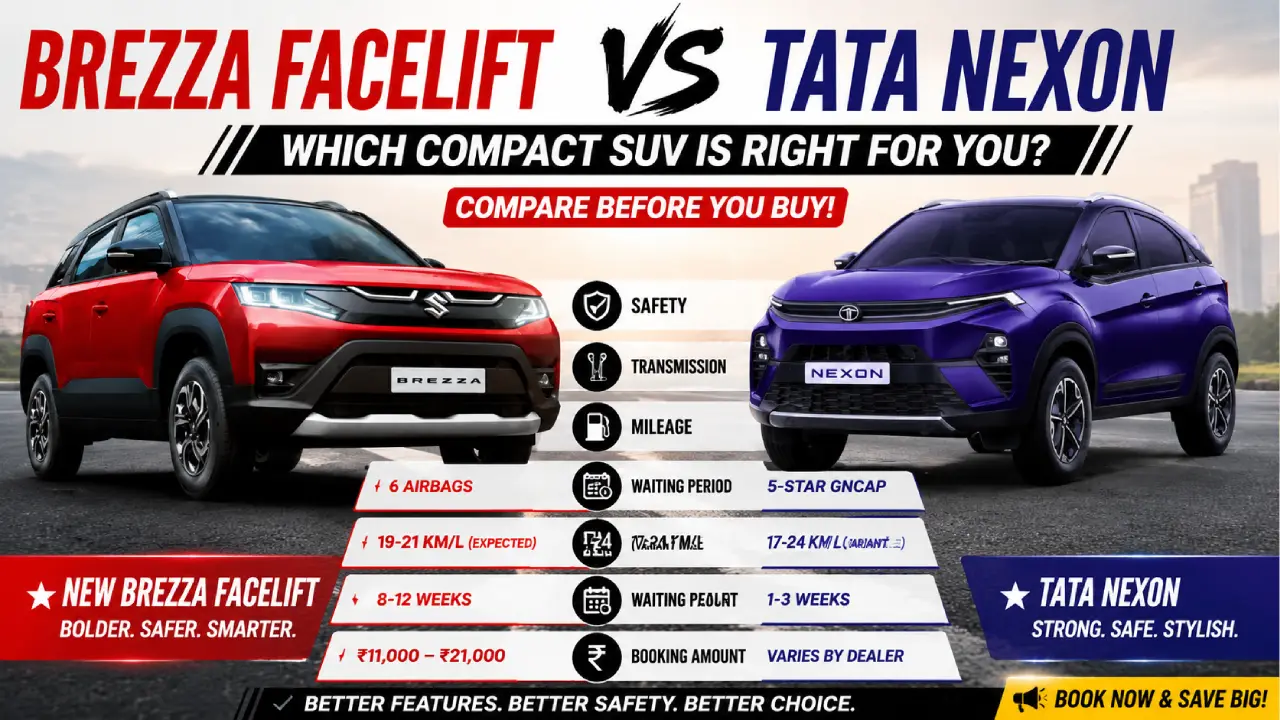
    Fuel efficiency remains one of Maruti Suzuki’s biggest advantages. The Brezza Facelift is expected to deliver around 19–21 km/l depending on transmission and driving conditions.

    The Tata Nexon petrol generally offers around 17–19 km/l, while the diesel version can deliver nearly 23–24 km/l under favorable driving conditions.

    If your daily commute is mostly within the city, the Brezza may help reduce monthly fuel expenses. However, highway users who cover long distances may benefit from Nexon’s diesel variant.

    Expected Price and Availability

    The Brezza Facelift is expected to be priced competitively, making it attractive for first-time SUV buyers. Meanwhile, Tata dealers are currently offering attractive exchange bonuses, finance offers, and limited-period discounts on selected Nexon variants in several cities.

    Before making a booking, buyers should always compare on-road prices, insurance packages, waiting periods, and dealer offers in their respective cities.

    Brezza Facelift vs Tata Nexon Specifications

    Feature Maruti Brezza Facelift Tata Nexon
    Engine 1.5L Petrol 1.2L Turbo Petrol / 1.5L Diesel
    Transmission Manual / 6-Speed Automatic Manual / AMT / DCT
    Mileage 19–21 km/l (Expected) 17–24 km/l (Variant Wise)
    Safety 6 Airbags, ESC, Hill Hold 5-Star Safety, ESC, 6 Airbags
    Best For City Driving & Mileage Safety & Performance

    Final Verdict: Which SUV Should You Buy?

    If your priority is fuel efficiency, low maintenance, and Maruti Suzuki’s extensive service network, the Brezza Facelift is an excellent choice. It offers refined performance, practical features, and comfortable daily usability.

    However, if maximum safety, multiple engine options, premium interiors, and stronger road presence matter more to you, the Tata Nexon continues to be one of the strongest contenders in the compact SUV segment.

    Ultimately, both SUVs offer impressive value under their respective price brackets. Your final decision should depend on your budget, driving habits, and feature preferences rather than marketing claims alone.

    Frequently Asked Questions

    Q1. Which SUV is safer, Brezza Facelift or Tata Nexon?
    Tata Nexon has built a strong reputation for safety thanks to its excellent crash-test performance. However, the Brezza Facelift also offers modern safety features like ESC and multiple airbags.

    Q2. Which SUV offers better mileage?
    The Maruti Brezza generally delivers better petrol fuel efficiency, while the Tata Nexon diesel provides excellent mileage for long-distance users.

    Q3. Which SUV is better for city driving?
    The Brezza is easier to drive in daily traffic because of its smooth petrol engine, lighter steering, and excellent service network. Meanwhile, Nexon suits buyers looking for extra safety and performance.

    New Brezza Facelift vs Tata Nexon: Which SUV Offers Better Value Before You Buy?

    Compare the new Maruti Brezza Facelift and Tata Nexon in terms of design, safety, mileage, engine, features, price, and value. Find out which compact SUV is the better choice for your family.
  • Petrol Prices Rising? Bring Home This Electric Scooter Under ₹1 Lakh, Save Big Every Month

    Petrol Prices Rising? Bring Home This Electric Scooter Under ₹1 Lakh, Save Big Every Month

    With petrol prices rising again, affordable electric scooters under ₹1 lakh are becoming a practical choice for city riders looking to reduce monthly fuel expenses.

    Best Electric Scooters Under ₹1 Lakh in India 2026

    The latest petrol price revision has once again increased the cost of daily commuting for millions of Indian riders. As fuel expenses continue to rise, many buyers are now considering electric scooters as a smarter long-term investment. Fortunately, several reliable electric scooters are available under ₹1 lakh, offering low running costs, practical range and modern features for urban use.

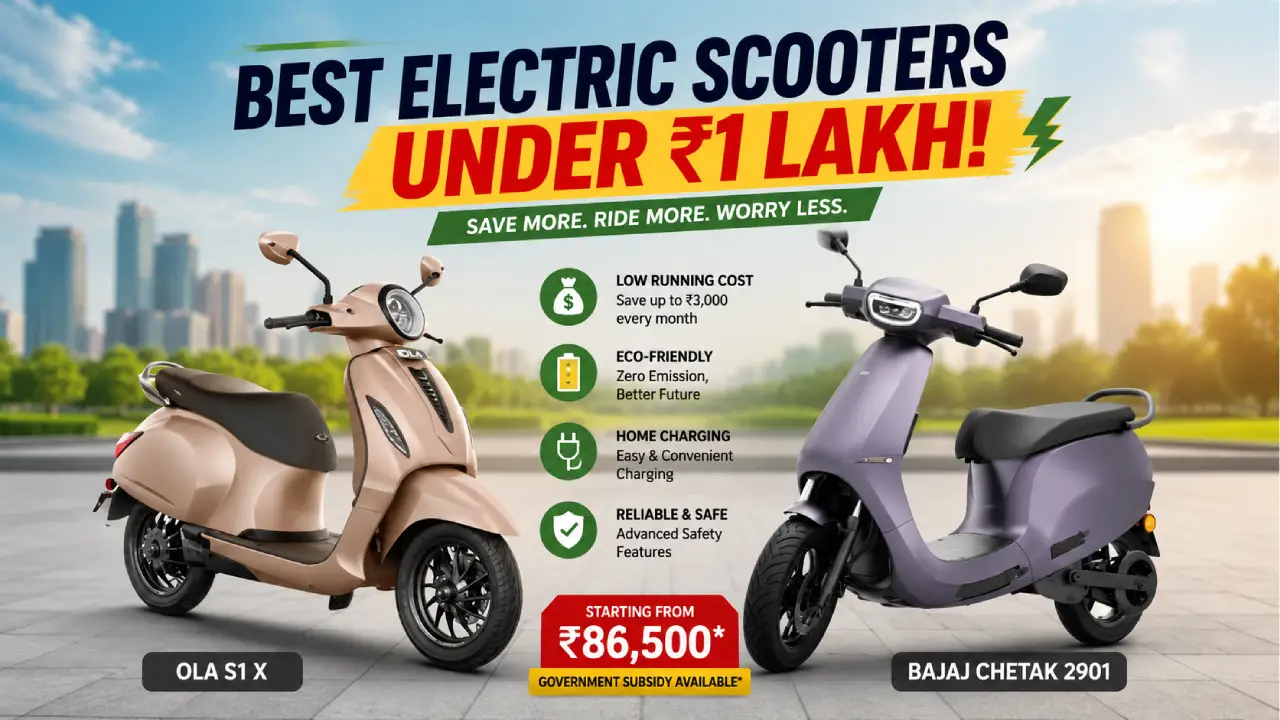
    Among the most searched options today are the Ola S1 X, Bajaj Chetak 2901 and TVS iQube. These models cater to office commuters, students and families who want to reduce dependence on petrol without spending a premium amount.

    Why Electric Scooters Are Becoming More Popular

    In cities such as Delhi, Mumbai and Bengaluru, the monthly fuel bill for a 125cc petrol scooter can easily cross ₹3,000–₹3,500 for riders covering around 30 km per day. In contrast, charging an electric scooter at home usually costs less than ₹500 per month.

    Moreover, electric scooters require fewer moving parts than conventional petrol scooters. As a result, routine maintenance costs are generally lower. This makes them attractive not only for fuel savings but also for reduced servicing expenses over time.

    Government incentives in some states further improve the value proposition, especially for entry-level electric scooters.

    Ola S1 X: The Most Affordable Option

    The Ola S1 X remains one of the most budget-friendly electric scooters currently available. Its lightweight design and simple feature set make it ideal for first-time EV buyers.

    Furthermore, the 2 kWh battery pack is sufficient for daily city commuting. Riders who travel short to medium distances every day can comfortably manage office trips, college runs and local errands without worrying about frequent charging.

    For buyers focused purely on affordability and low running costs, the Ola S1 X offers excellent value under the ₹90,000 mark in Delhi.

    Bajaj Chetak 2901: Premium Feel on a Budget

    The Bajaj Chetak 2901 brings a more premium design language to the budget EV segment. Its metal body construction gives it a sturdy and durable feel, which many buyers appreciate.

    Additionally, the larger 2.8 kWh battery pack offers a better real-world range than many entry-level competitors. Therefore, riders who regularly cover longer distances may find the Chetak 2901 more practical despite its slightly higher price. Bajaj’s widespread service network also adds confidence for long-term ownership.

    TVS iQube: Balanced Performance and Features

    The TVS iQube has built a strong reputation for refinement and reliability. The entry-level variant remains within the ₹1 lakh budget while offering a good mix of performance, comfort and technology.

    Moreover, TVS has focused on smooth acceleration and user-friendly riding characteristics. Consequently, the iQube appeals to both younger riders and family users looking for a dependable daily commuter.

    Its practical range and comfortable ergonomics make it suitable for regular urban use.

    Electric Scooter Price and Battery Comparison

    | Model | Battery | Approx. Price (Delhi) |
    | —————– | ——- | ——————— |
    | Ola S1 X | 2.0 kWh | ₹86,500 |
    | Bajaj Chetak 2901 | 2.8 kWh | ₹99,200 |
    | TVS iQube | 2.2 kWh | ₹98,900 |

    How Much Can You Save Every Month?

    Let’s assume a rider travels around 30 km every day.

    | Vehicle Type | Monthly Running Cost |
    | —————– | ——————– |
    | Petrol Scooter | ₹3,000–₹3,500 |
    | Electric Scooter | ₹400–₹500 |
    | Estimated Savings | ₹2,500–₹3,000 |

    Over a year, the savings can exceed ₹30,000, which is substantial for regular commuters.

    Monsoon Safety Tips for Electric Scooter Buyers

    During the rainy season, buyers should pay special attention to water protection and tyre grip.

    Before purchasing, check whether the scooter has an IP67-rated motor or battery protection. This helps protect critical electrical components from water exposure. However, riders should still avoid deep waterlogging, especially when the water level rises above the wheel hub.

    Additionally, inspect the brakes regularly. Many budget electric scooters use drum brakes, which require periodic maintenance for consistent performance in wet conditions.

    Which Electric Scooter Should You Buy?

    If your priority is the lowest purchase price and maximum savings, the Ola S1 X is difficult to ignore.

    If you want a more premium feel and better range, the Bajaj Chetak 2901 makes a strong case.

    Meanwhile, the TVS iQube is ideal for buyers looking for a balanced package of comfort, features and reliability.

    Ultimately, the right choice depends on your daily travel distance, charging availability at home and long-term ownership expectations.

    Final Verdict

    Rising petrol prices have made electric scooters more relevant than ever. For urban commuters, a budget EV can significantly reduce monthly transportation expenses while offering a quiet and convenient riding experience.

    Among the options under ₹1 lakh, the Ola S1 X stands out for affordability, the Bajaj Chetak 2901 impresses with its premium appeal, and the TVS iQube delivers the most balanced ownership experience.

    Before booking, compare real-world range, charging convenience and local dealer support. A well-chosen electric scooter can help you save money every single month while preparing for a future with higher fuel prices.

    FAQs

    Q1. Which electric scooter under ₹1 lakh offers the lowest running cost?

    The Ola S1 X generally offers one of the lowest running costs thanks to its efficient battery and lightweight design.

    Q2. Is the Bajaj Chetak 2901 suitable for daily office commuting?

    Yes. Its larger battery pack and comfortable ride make it a practical option for daily city commuting.

    Q3. Can electric scooters be used safely during the monsoon?

    Yes, provided the scooter has adequate water protection, good tyre grip and is not ridden through deep waterlogged roads.

  • Bring Home a Safe Hatchback Under ₹10 Lakh–Top 3 Rain-Ready Cars with 6 Airbags & Great Discounts

    Bring Home a Safe Hatchback Under ₹10 Lakh–Top 3 Rain-Ready Cars with 6 Airbags & Great Discounts

    Heavy monsoon showers make road safety more important than ever. If you’re planning to buy a budget-friendly hatchback, these three cars under ₹10 lakh offer impressive safety, modern features, and confident driving in wet conditions.

    Best Cars Under ₹10 Lakh for Rainy Season Driving

    Buying a new car during the monsoon requires more than simply checking its mileage or price. Wet roads, poor visibility, and sudden waterlogging demand a vehicle that can inspire confidence in every situation. Fortunately, several hatchbacks in India now offer advanced safety features that were once available only in premium vehicles.

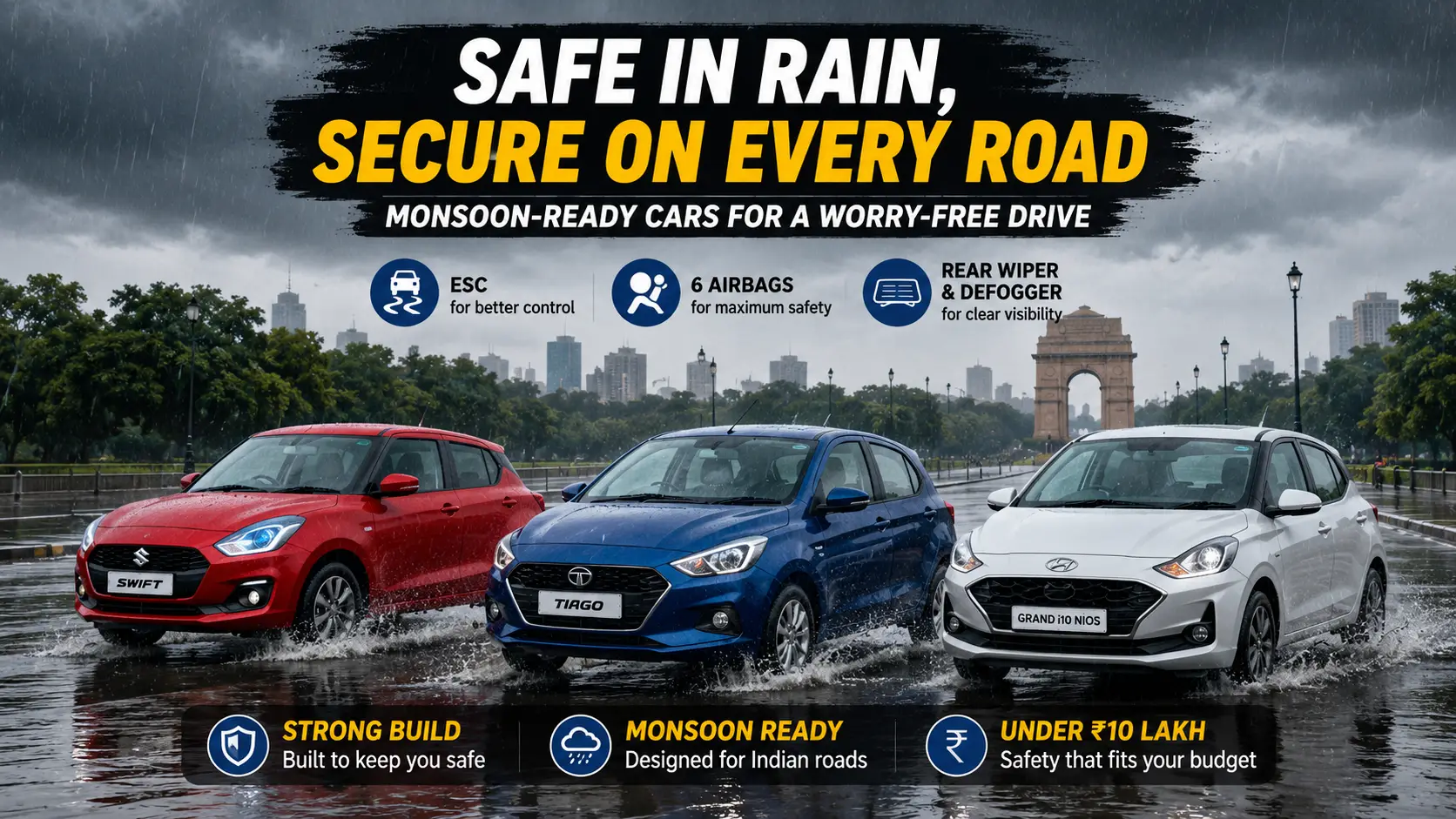
    If your budget is below ₹10 lakh, models such as the Maruti Swift, Tata Tiago, and Hyundai Grand i10 Nios deserve serious consideration. Moreover, these cars combine affordability with practical safety technology, making them ideal companions for everyday commuting during the rainy season.

    Besides attractive pricing, many dealerships are currently offering exchange bonuses, corporate discounts, and faster deliveries on selected variants. Therefore, this could be the right time to upgrade to a safer hatchback.

    Why Safety Features Matter More During the Monsoon

    Driving in heavy rain presents several challenges. Slippery roads reduce tyre grip, while poor visibility increases the chances of sudden braking. Consequently, modern safety technologies play a major role in preventing accidents.

    Electronic Stability Control (ESC) has become one of the most valuable safety systems available in affordable hatchbacks. It automatically applies braking to individual wheels whenever it detects loss of traction. As a result, drivers enjoy better stability while taking sharp turns or avoiding unexpected obstacles.

    Additionally, features such as six airbags, ABS with EBD, Hill Hold Assist, rear wipers, rear defoggers, and reverse parking sensors further improve confidence during rainy-day driving.

    Maruti Swift: Balanced Performance with Modern Safety

    The latest Maruti Swift continues to remain one of India’s best-selling hatchbacks because of its dependable performance, refined engine, and affordable maintenance costs.

    Moreover, several variants now offer six airbags and Electronic Stability Control, significantly improving passenger safety. Hill Hold Assist also proves useful while driving on slippery flyovers and inclined roads during heavy rainfall.

    The Swift’s lightweight design and responsive steering make city driving easy. Meanwhile, its fuel-efficient petrol engine continues to deliver excellent mileage without compromising everyday usability.

    Tata Tiago: Strong Build Quality for Peace of Mind

    Tata Motors has built a strong reputation for producing safe passenger vehicles, and the Tiago is no exception. The hatchback is widely appreciated for its robust body structure and reassuring driving feel.

    Furthermore, its stable suspension setup provides better confidence over broken roads and uneven surfaces commonly found during the monsoon. While driving through waterlogged streets, the Tiago feels planted and composed.

    Another advantage is Tata’s focus on structural safety. Combined with dual airbags, ABS, rear parking sensors, and strong body construction, the Tiago remains one of the safest budget hatchbacks available today.

    Hyundai Grand i10 Nios: Comfort Meets Everyday Practicality

    The Hyundai Grand i10 Nios appeals to buyers looking for premium comfort within a reasonable budget. Besides its stylish exterior, the hatchback offers a feature-rich cabin that makes daily commuting enjoyable.

    Many variants now include six airbags, ESC, rear defogger, and rear wiper, all of which become especially useful during rainy weather. Moreover, Hyundai’s smooth engine and light steering reduce driver fatigue in congested urban traffic.

    The cabin also feels spacious enough for family use, while the suspension handles city roads comfortably even during continuous rainfall.

    Comparison of the Best Monsoon-Friendly Hatchbacks Under ₹10 Lakh

    Model Key Rain Safety Feature Safety Highlights Approx Price
    Maruti Swift Electronic Stability Control, Hill Hold Assist 6 Airbags, ABS, ESC ₹6.5–9.8 lakh
    Tata Tiago Strong Body Structure ABS, Dual Airbags, Rear Sensors ₹5.7–8.8 lakh
    Hyundai Grand i10 Nios Rear Defogger, ESC 6 Airbags, ESC, ABS ₹6–9.5 lakh

    Rain Driving Tips Every New Car Buyer Should Follow

    Even the safest vehicle requires careful driving during heavy rain. Therefore, always inspect tyre tread depth before beginning a long journey. Worn-out tyres significantly increase the chances of aquaplaning.

    Similarly, maintain proper tyre pressure because both underinflated and overinflated tyres reduce grip on wet roads.

    Avoid driving through deep water whenever possible. Although hatchbacks offer decent ground clearance, excessive water can damage the engine if it enters the air intake. Consequently, always drive slowly through shallow water while maintaining a steady speed.

    Keep your headlights switched on during heavy rainfall to improve visibility for other road users. Moreover, regularly check the condition of your windshield wipers and washer fluid for clear vision.

    Current Discounts and Buying Opportunities

    Several dealerships across major Indian cities are currently offering attractive benefits on hatchback models under ₹10 lakh. Exchange bonuses, loyalty discounts, corporate offers, and finance schemes have made these vehicles even more affordable.

    Furthermore, popular colour options such as Silver, White, and Grey are readily available at many dealerships, allowing buyers to receive quicker deliveries. However, offers may vary depending on the city and dealer inventory.

    Final Verdict

    If safety is your highest priority during the rainy season, all three hatchbacks offer excellent value within a budget of ₹10 lakh. The Maruti Swift stands out with its balanced performance and modern safety technology. Meanwhile, the Tata Tiago impresses buyers looking for a solid body structure and confidence on rough roads. On the other hand, the Hyundai Grand i10 Nios provides a premium cabin, advanced convenience features, and dependable everyday comfort.

    Ultimately, the right choice depends on your driving habits, daily commute, and feature preferences. Nevertheless, investing in a car equipped with Electronic Stability Control, multiple airbags, and essential monsoon-friendly features will always be a smarter decision for safer family travel.

    Frequently Asked Questions

    Q1. Which is the safest hatchback under ₹10 lakh?

    The Tata Tiago is well known for its strong body structure, while the latest Maruti Swift and Hyundai Grand i10 Nios also offer advanced safety features such as six airbags and Electronic Stability Control in selected variants.

    Q2. Is Electronic Stability Control important during the rainy season?

    Yes. ESC helps prevent skidding by automatically applying braking to individual wheels, improving stability on slippery roads.

    Q3. Which hatchback offers the best value for daily city driving?

    Maruti Swift remains an excellent all-round option because of its fuel efficiency, low maintenance costs, comfortable ride, and comprehensive safety features in higher variants.

  • Honda Activa 6G or TVS Jupiter? Check the Safest Scooter for Monsoon Rides Before You Book

    Honda Activa 6G or TVS Jupiter? Check the Safest Scooter for Monsoon Rides Before You Book

    Honda Activa 6G or TVS Jupiter Looking for the safest scooter to ride during the monsoon? Here’s a detailed comparison of the Honda Activa 6G and TVS Jupiter, covering safety, stability, braking, features, pricing, and everyday practicality for Indian riders.

    Honda Activa 6G vs TVS Jupiter: Which Scooter Is Better for Monsoon Riding?

    The monsoon season brings welcome relief from the summer heat, but it also creates challenging road conditions. Waterlogged streets, slippery corners, and poor visibility make everyday commuting more difficult. Therefore, choosing a scooter that offers confidence, stability, and reliable braking becomes more important than ever.

    Among India’s best-selling scooters, the Honda Activa 6G and the TVS Jupiter 110 continue to dominate the market. Both models have earned a strong reputation for reliability, fuel efficiency, and comfortable daily commuting. However, each scooter has its own strengths when it comes to riding safely during heavy rain.

    If you are planning to purchase a new scooter this season, this comparison will help you understand which model suits your riding needs better.

    Honda Activa 6G vs TVS Jupiter Safety and Braking Performance

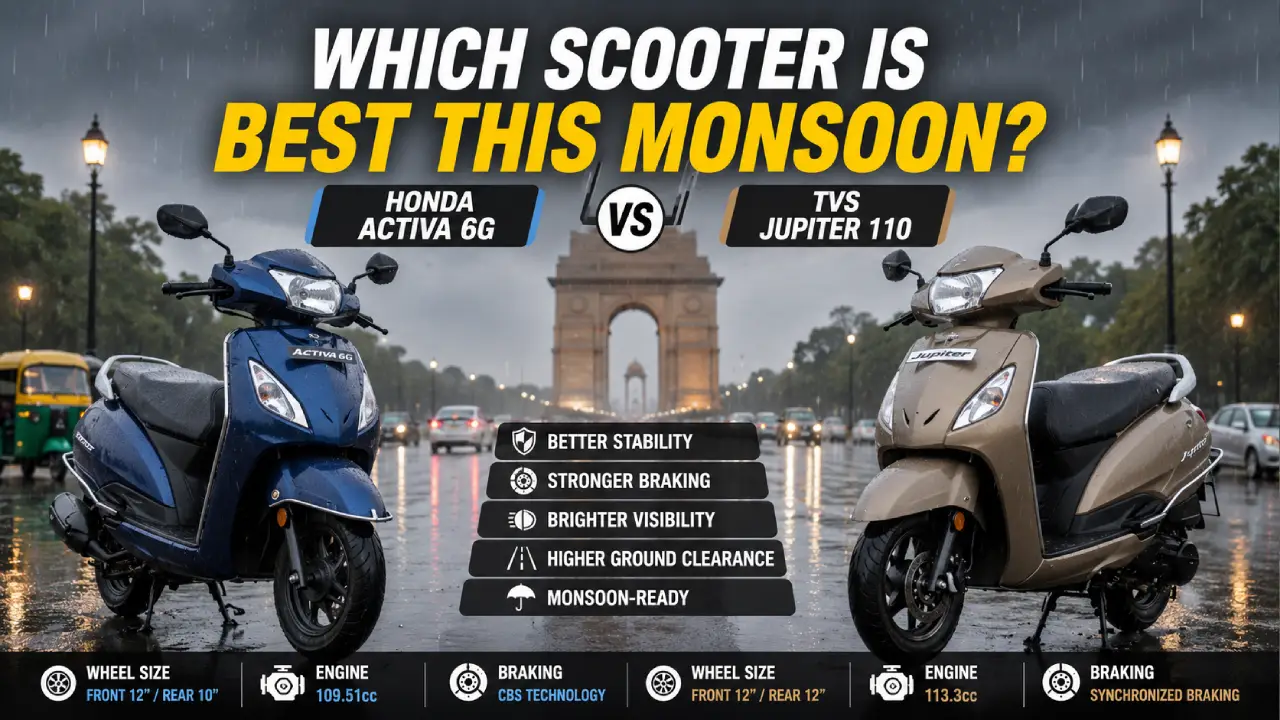
    During rainy weather, braking performance can make a significant difference. Honda equips the Activa 6G with its trusted Combi Brake System (CBS), which distributes braking force between both wheels for better balance. Consequently, sudden braking feels smoother and more controlled, especially for new riders.

    Meanwhile, the TVS Jupiter features a synchronized braking system that also improves stopping confidence on wet roads. Moreover, the scooter’s suspension setup absorbs uneven surfaces effectively, allowing riders to maintain better control over potholes and broken city roads.

    Although both scooters deliver dependable braking, riders should always avoid sudden acceleration or hard braking while riding on slippery surfaces.

    Wheel Size and Stability on Wet Roads

    Wheel size directly affects balance and confidence during the rainy season. The TVS Jupiter enjoys a slight advantage because it comes with 12-inch wheels at both the front and rear. Larger rear wheels generally improve stability while riding over water-filled potholes and uneven roads.

    On the other hand, the Honda Activa 6G features a 12-inch front wheel and a 10-inch rear wheel. Despite the smaller rear wheel, Honda has tuned the suspension well, making the scooter comfortable and predictable for city riding.

    For riders who regularly travel on rough or poorly maintained roads, the Jupiter may feel slightly more planted during the monsoon.

    Feature Honda Activa 6G TVS Jupiter 110
    Front Wheel 12-inch 12-inch
    Rear Wheel 10-inch 12-inch
    Braking System Combi Brake System (CBS) Synchronized Braking
    Ground Clearance 162 mm 163 mm
    LED Headlamp Select Variants Select Variants

    Ground Clearance and Waterlogged Roads

    Ground clearance becomes extremely important when roads are flooded after heavy rain. The Honda Activa 6G offers approximately 162 mm of ground clearance, while the TVS Jupiter provides around 163 mm. The difference is minimal, meaning both scooters handle normal urban speed breakers and shallow water reasonably well.

    However, riders should remember that scooters are not designed for deep water crossings. Therefore, always avoid roads where water rises above the wheel hub, as this may damage the engine, transmission, or electrical components.

    Comfort and Everyday Practicality

    Both scooters have been designed primarily for daily commuting. The Honda Activa 6G offers a refined engine, smooth throttle response, and comfortable ergonomics, making it an excellent choice for short office commutes and family use. Furthermore, Honda’s widespread service network ensures hassle-free ownership across India.

    Meanwhile, the TVS Jupiter focuses heavily on rider comfort. Its spacious seat, practical storage options, and well-balanced chassis make longer rides less tiring. Moreover, the larger wheels provide extra confidence during extended highway or suburban rides in wet conditions.

    If your daily commute is under 10 km, the Activa 6G remains an excellent option. However, riders covering longer distances every day may appreciate the Jupiter’s additional stability and comfort.

    Price, EMI Options and Value for Money

    The Honda Activa 6G remains one of the most affordable and trusted scooters in its segment, with on-road prices starting at around ₹90,000 in many cities, depending on the variant and location. Meanwhile, TVS dealers continue to attract buyers through flexible EMI schemes, exchange bonuses, and festive cashback offers.

    Additionally, both manufacturers offer multiple color choices, extended warranty packages, and attractive finance options, making ownership easier for first-time buyers.

    Final Verdict: Which Scooter Should You Buy This Monsoon?

    Choosing between the Honda Activa 6G and the TVS Jupiter ultimately depends on your riding requirements.

    If you value proven reliability, smooth engine performance, easy maintenance, and a trusted ownership experience, the Honda Activa 6G continues to be one of the safest choices for everyday commuting.

    On the other hand, if you regularly ride longer distances or frequently encounter rough roads during the rainy season, the TVS Jupiter offers an advantage with its larger rear wheel and balanced ride quality.

    Regardless of which scooter you choose, always check tyre pressure, inspect brake performance, wear a certified helmet, and reduce speed during heavy rainfall. Safe riding habits remain the most important safety feature on any scooter.

    Frequently Asked Questions

    Q1. Which scooter is better for rainy roads, Honda Activa 6G or TVS Jupiter?
    Both scooters perform well during the monsoon, but the TVS Jupiter offers slightly better stability thanks to its 12-inch wheels at both ends.

    Q2. Does Honda Activa 6G have better braking?
    Honda Activa 6G features a reliable Combi Brake System (CBS) that provides balanced braking for everyday city riding.

    Q3. Can I ride these scooters through waterlogged roads?
    Both scooters can handle shallow water, but riders should avoid water levels above the wheel hub to reduce the risk of engine or electrical damage.

  • Buy a Premium Sedan Under ₹12 Lakh with Easy EMI, 6 Airbags & Great Deals -Best Family Cars 2026

    Buy a Premium Sedan Under ₹12 Lakh with Easy EMI, 6 Airbags & Great Deals -Best Family Cars 2026

    Looking for the best sedan under ₹12 lakh? Here is a detailed comparison of India’s most popular family sedans based on safety, features, pricing, comfort, mileage, and value for money before you book your next car.

    Why Sedan Cars Under ₹12 Lakh Continue to Attract Indian Families

    Despite the growing popularity of SUVs, sedans continue to remain a practical choice for thousands of Indian buyers. They offer a comfortable cabin, smoother highway performance, better fuel efficiency, and a premium driving experience without stretching the budget.

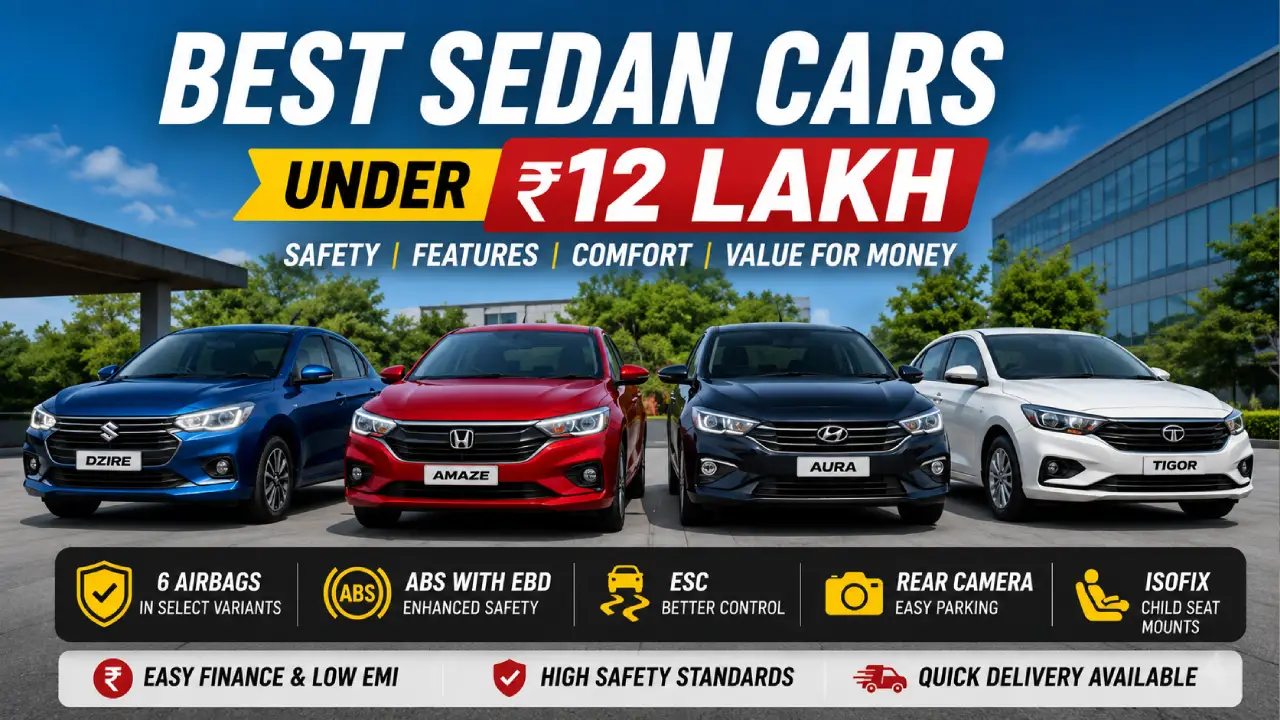
    Moreover, buyers today are paying far more attention to safety than ever before. Features like six airbags, ABS, Electronic Stability Control (ESC), reverse parking camera, hill-start assist, and ISOFIX child-seat mounts have become important deciding factors. As a result, manufacturers are offering more standard safety equipment even in entry-level variants.

    If your budget is below ₹12 lakh, models such as the Maruti Suzuki Dzire, Honda Amaze, Tata Tigor, and Hyundai Aura offer an excellent combination of affordability, comfort, and long-term ownership value.

    Best Sedan Cars Under ₹12 Lakh in India

    Each sedan has its own strengths. Therefore, your final choice should depend on your daily driving pattern, family requirements, service availability, and ownership costs.

    Model Estimated On-Road Price Best For
    Maruti Suzuki Dzire VXi ₹8.45 Lakh Mileage & Low Maintenance
    Honda Amaze S ₹9.60 Lakh Comfort & Reliability
    Hyundai Aura S ₹9.85 Lakh Features & City Driving
    Tata Tigor XZ+ ₹9.10 Lakh Safety & Build Quality

    These prices may vary depending on the city, registration charges, insurance, and dealer offers.

    Safety Features Buyers Should Not Ignore

    Safety has become one of the biggest priorities for Indian families. Fortunately, modern budget sedans now offer significantly better protection than previous generations.

    Many variants now include dual or six airbags, ABS with EBD, Electronic Stability Control, rear parking sensors, seatbelt reminders, and high-speed alerts. Meanwhile, higher trims also offer rear-view cameras, TPMS, and automatic headlamps.

    Therefore, before making a purchase, compare the standard safety equipment instead of choosing a vehicle based only on price.

    Comfort and Daily Driving Experience

    One of the biggest advantages of a sedan is ride comfort. Compared with many compact SUVs, sedans generally provide better stability on highways and a smoother suspension setup.

    The Honda Amaze delivers a refined driving experience and a spacious cabin for small families. Meanwhile, the Maruti Dzire continues to impress with its light steering, excellent visibility, and low running costs.

    On the other hand, buyers looking for a stronger body structure often consider the Tata Tigor, while the Hyundai Aura attracts customers with its feature-rich cabin and premium interior quality.

    Easy Finance Plans Make Buying Simpler

    Another reason behind the growing demand is the availability of flexible finance options. Today, many dealerships offer attractive EMI schemes with around 20% down payment, making sedan ownership easier for middle-class families.

    Moreover, buyers can also benefit from exchange bonuses, loyalty discounts, corporate offers, and festive finance schemes depending on the dealership. Therefore, comparing offers from multiple dealers before booking can help reduce the overall ownership cost.

    Maintenance, Tyres and Long-Term Ownership Costs

    Owning a sedan is not only about the purchase price. Long-term maintenance also plays an important role in the overall budget.

    Most sedan tyres typically last between 40,000 and 50,000 kilometres depending on driving habits and road conditions. Regular wheel alignment, tyre rotation, and proper tyre pressure improve both safety and fuel efficiency.

    Additionally, following the manufacturer’s recommended service schedule helps maintain engine performance while reducing unexpected repair expenses. Buyers planning to keep the vehicle for several years should also consider purchasing an extended warranty and engine protection package.

    Should You Book a Sedan Now?

    If you have already decided to purchase a family sedan, this could be a suitable time to compare available stock and dealership offers. Ready-stock vehicles often come with quicker delivery and, in some cases, additional dealer discounts.

    However, instead of rushing into a decision, compare the final on-road price, warranty benefits, service network, insurance package, and after-sales support. A careful comparison will help you choose a sedan that fits both your budget and your family’s future needs.

    Whether you prioritise mileage, comfort, safety, or maintenance costs, the current generation of budget sedans offers excellent value. With the right planning, you can own a feature-rich and dependable family car without exceeding your ₹12 lakh budget.

    Final Verdict

    The Maruti Suzuki Dzire remains an excellent choice for buyers focused on mileage and affordable ownership. The Honda Amaze stands out for refinement and comfort, while the Tata Tigor appeals to safety-conscious families. Meanwhile, the Hyundai Aura offers a premium feature list for everyday city driving.

    Before booking, always compare dealer discounts, warranty coverage, financing options, and service support to get the best overall value.

    Frequently Asked Questions (FAQs)

    Q1. Which is the best sedan under ₹12 lakh for families?
    The Maruti Dzire, Honda Amaze, Tata Tigor, and Hyundai Aura are among the best family sedans, depending on whether you prioritise mileage, comfort, safety, or features.

    Q2. Which sedan offers the lowest maintenance cost?
    The Maruti Suzuki Dzire generally offers one of the lowest maintenance costs thanks to its extensive service network and affordable spare parts.

    Q3. Should I buy a sedan or a compact SUV under ₹12 lakh?
    If you value ride comfort, fuel efficiency, and highway stability, a sedan remains an excellent option. Buyers needing higher ground clearance may prefer a compact SUV.

  • Heavy Rain Alert in the Hills: These 4 Budget Bikes Are the Safest Choice for Slippery Mountain Roads

    Heavy Rain Alert in the Hills: These 4 Budget Bikes Are the Safest Choice for Slippery Mountain Roads

    Heavy rainfall across Himachal Pradesh and Uttarakhand has made mountain roads more challenging than ever. Choosing a reliable commuter motorcycle with good ground clearance, stable braking, and dependable handling can make every ride safer during the monsoon.

    Heavy Rain Alert in Himachal and Uttarakhand: Why Choosing the Right Bike Matters

    Continuous rainfall in northern hill states has increased the risk of slippery roads, waterlogging, and landslides. As a result, daily commuters, delivery riders, and rural travelers need motorcycles that remain stable even in difficult road conditions. A lightweight motorcycle with predictable handling often performs better than a heavier machine on narrow mountain roads.

    Moreover, riders should never depend only on engine performance. Features such as efficient braking, durable tyres, high ground clearance, and comfortable ergonomics play an equally important role during monsoon riding. Therefore, selecting the right bike becomes an important safety decision rather than just a budget choice.

    Bajaj CT125X: Built for Tough Village Roads

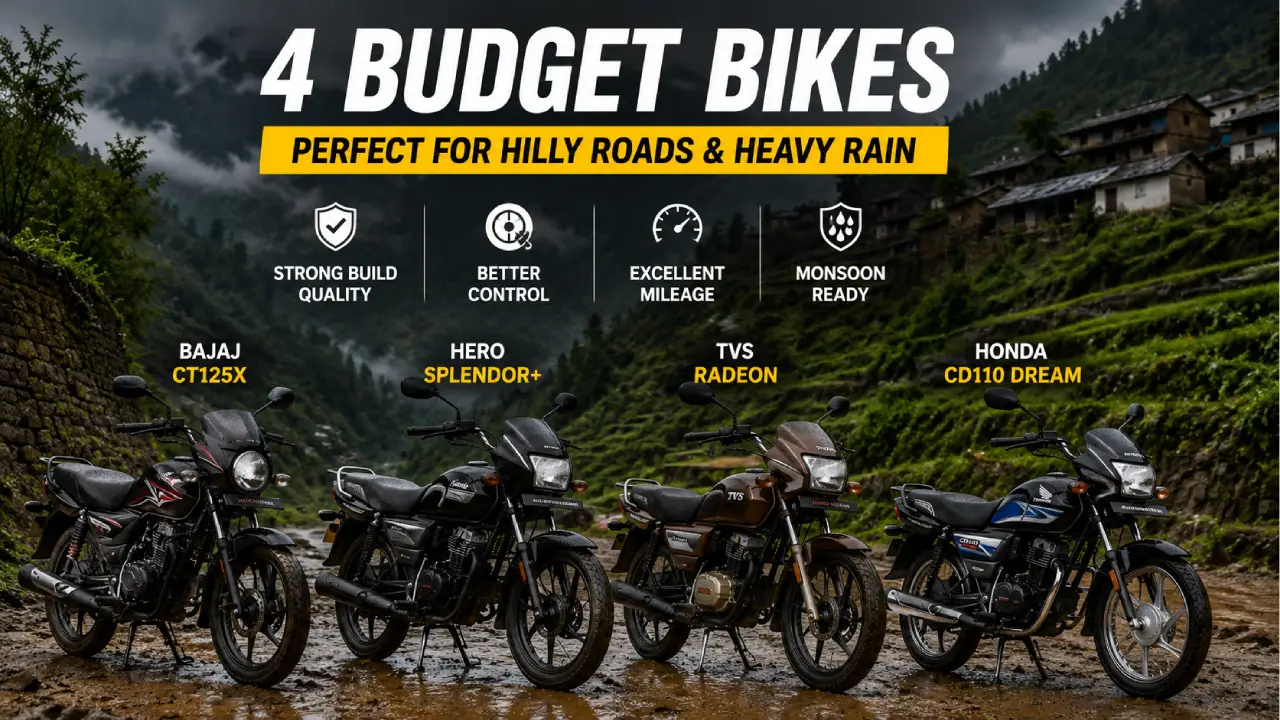
    The Bajaj CT125X has earned a reputation for handling rough terrain with confidence. Its strong double-cradle frame, practical suspension setup, and protective crash guards make it suitable for village roads and uneven mountain tracks.

    Additionally, the motorcycle comes equipped with a Combined Braking System (CBS), which improves braking stability during emergency stops. Meanwhile, its upright riding position keeps the rider comfortable even on long journeys through hilly regions.

    If your daily route includes broken roads, steep climbs, or gravel surfaces, the CT125X offers excellent value without stretching your budget.

    Hero Splendor+ and HF 100: Proven Reliability in Every Season

    The Hero Splendor+ continues to be one of India’s most trusted commuter motorcycles. Its fuel-efficient engine, simple maintenance, and dependable reliability make it an ideal choice for riders who travel daily through rural and semi-urban areas.

    Meanwhile, the Hero HF 100 offers a similarly dependable package at an even more affordable price. Both motorcycles feature sealed chain systems that require less maintenance during the rainy season, helping reduce wear caused by mud and water.

    Furthermore, Hero’s extensive service network ensures easy access to spare parts, even in smaller towns located near hill stations.

    TVS Radeon and Honda CD110 Dream for Mountain Riding

    The TVS Radeon stands out because of its comfortable suspension and impressive ground clearance. Consequently, riders experience better confidence while crossing potholes, rocky paths, and uneven village roads.

    On the other hand, the Honda CD110 Dream focuses on everyday practicality. Its tubeless tyres help reduce the inconvenience of punctures caused by sharp stones commonly found on mountain roads. Moreover, Honda’s refined engine delivers smooth performance while maintaining excellent fuel efficiency.

    For riders looking for an economical commuter with dependable reliability, both motorcycles remain strong contenders.

    Comparison of the Best Budget Bikes for Rainy Mountain Roads

    Motorcycle Engine Key Highlight
    Bajaj CT125X 124.4cc Double-cradle frame, CBS
    Hero Splendor+ 97.2cc Reliable engine, sealed chain
    TVS Radeon 109.7cc High ground clearance, comfortable suspension
    Honda CD110 Dream 109.5cc Tubeless tyres, refined engine

    Essential Safety Tips Before Riding During Heavy Rain

    Even the safest motorcycle cannot compensate for unsafe riding habits. Therefore, inspect your tyres before every ride and ensure sufficient tread depth. Additionally, check the brake pads, chain lubrication, and headlamp performance before heading into the hills.

    Avoid entering flooded roads if the water level reaches above the wheel hub. Moreover, maintain a safe distance from other vehicles and reduce speed while cornering. Sudden acceleration or hard braking on wet roads can easily lead to loss of traction.

    If weather forecasts predict landslides or extremely heavy rainfall, postponing the journey is often the safest decision.

    Final Verdict

    Choosing the right commuter motorcycle can significantly improve safety during the monsoon season. The Bajaj CT125X is ideal for rough rural roads, while the Hero Splendor+ continues to be the benchmark for reliability. Meanwhile, the TVS Radeon offers excellent comfort and ground clearance, whereas the Honda CD110 Dream impresses with refinement and practical ownership.

    Before making your purchase, compare dealer offers, inspect safety features, and select the motorcycle that best matches your daily riding conditions. Safe riding habits combined with a dependable bike will always provide the best protection during heavy rains.

    Frequently Asked Questions

    Q1. Which motorcycle is best for riding on slippery mountain roads?
    The Bajaj CT125X and TVS Radeon are excellent choices because they offer strong suspension, stable handling, and good ground clearance.

    Q2. Are 100cc motorcycles suitable for hilly regions?
    Yes. Reliable models like the Hero Splendor+ and Honda CD110 Dream can comfortably handle daily commuting in hilly areas when ridden carefully.

    Q3. What should riders check before riding during heavy rain?
    Always inspect tyre condition, brake performance, lights, chain lubrication, and weather updates before starting your journey.

  • Bike Warranty Rejected? Avoid These E20 Fuel Mistakes Before It’s Too Late in 2026

    Bike Warranty Rejected? Avoid These E20 Fuel Mistakes Before It’s Too Late in 2026

    E20 fuel is becoming the new standard across India, but many motorcycle owners still have questions about warranty coverage. Here’s how you can protect your bike, avoid costly mistakes, and keep your warranty claim safe.

    E20 Fuel and Bike Warranty: What Every Rider Should Know

    The transition to E20 fuel has become one of the biggest changes for Indian motorcycle owners. While manufacturers continue introducing E20-compatible motorcycles, many riders remain uncertain about how the new fuel affects warranty coverage. Moreover, increasing discussions around engine issues and warranty disputes have encouraged owners to become more careful about routine maintenance.

    If you own a 100cc, 110cc, or 125cc commuter motorcycle, now is the right time to understand your bike’s E20 compatibility. Most modern motorcycles already support E20 fuel, but following the manufacturer’s maintenance schedule remains equally important. Therefore, keeping proper records can make a significant difference if you ever need to submit a warranty claim.

    Instead of worrying about rumors, focus on the maintenance practices recommended by your motorcycle manufacturer. A few simple habits can protect both your motorcycle and your hard-earned money.

    E20 Fuel Compatibility Check Before Every Fill-Up

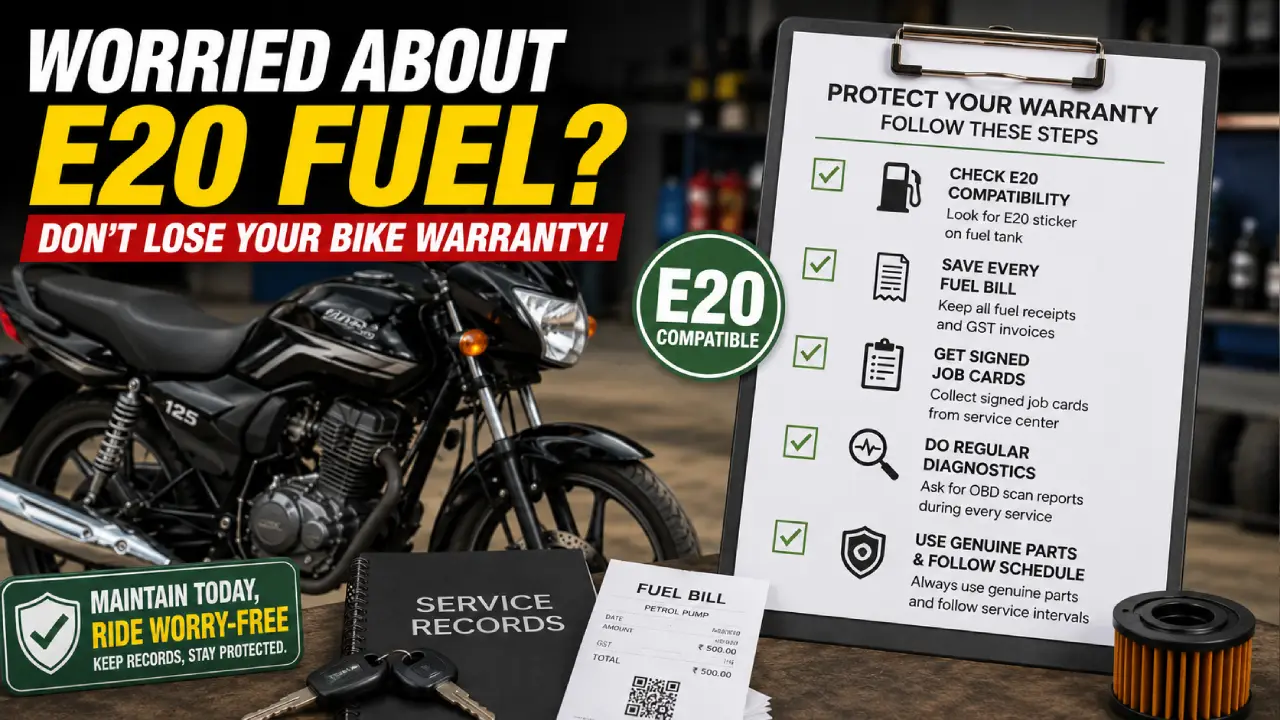
    The first step is confirming whether your motorcycle officially supports E20 fuel. Fortunately, most recently launched commuter bikes include an E20 compatibility sticker near the fuel tank or mention it inside the owner’s manual.

    Moreover, riders should never assume compatibility simply because a motorcycle looks new. Always verify the information from the manufacturer’s documentation. If you recently purchased a motorcycle, ask the dealership to confirm its fuel compatibility during delivery.

    Meanwhile, riders planning to buy a new bike should request written confirmation that the selected model is E20 compliant. This small step may prove valuable if any warranty-related questions arise later.

    Keep Every Service Record Safe

    Documentation has become more important than ever. Therefore, never throw away fuel bills, GST invoices, or service records after routine maintenance.

    Whenever your motorcycle visits an authorized service center, collect the signed job card before leaving. Additionally, request diagnostic reports whenever electronic inspections are performed. These documents help establish that the motorcycle received timely servicing according to company guidelines.

    Moreover, maintaining organized records creates a clear service history. If a warranty inspection takes place, these documents demonstrate responsible ownership and proper maintenance.

    Digital copies also help. Scan important invoices and save them securely in cloud storage or your smartphone. This prevents accidental loss of physical paperwork.

    Simple Maintenance Habits That Protect Your Engine

    Proper maintenance remains the easiest way to avoid engine-related concerns. During the rainy season, moisture becomes a common issue. Therefore, inspect the air filter regularly and replace it whenever necessary.

    Similarly, keep the fuel system clean according to the manufacturer’s service schedule. Fuel filters should receive attention whenever recommended during periodic servicing.

    If you notice unusual engine knocking, rough idling, poor acceleration, or increased fuel consumption, visit an authorized workshop immediately. Moreover, request that the technician records these observations on the official service document.

    Ignoring minor warning signs can sometimes result in larger repair bills later. Early diagnosis often prevents expensive mechanical damage.

    What to Do If Your Warranty Claim Faces Problems

    Sometimes warranty claims require additional technical inspection before approval. If your dealership raises concerns regarding fuel quality or maintenance history, remain calm and request written explanations.

    Moreover, avoid signing any document unless you clearly understand its contents. If the dealership believes contaminated fuel caused the problem, ask for supporting inspection details and proper documentation.

    Meanwhile, preserve all servicing records, fuel purchase receipts, and maintenance invoices. These papers may help explain your motorcycle’s maintenance history if further clarification becomes necessary.

    Professional communication always produces better results than emotional arguments. Therefore, keep every discussion documented whenever possible.

    E20 Fuel Safety Tips for Daily Riders

    Daily commuters can reduce long-term maintenance costs by following a few practical habits. Always purchase fuel from trusted filling stations with proper billing facilities. Moreover, avoid storing fuel for extended periods whenever possible.

    During monsoon months, protect the motorcycle from excessive moisture. Water contamination inside the fuel system may affect overall performance. Likewise, inspect the fuel cap seal regularly to ensure it remains in good condition.

    If your motorcycle remains unused for several weeks, start the engine periodically according to the manufacturer’s recommendations. This simple habit helps maintain fuel circulation throughout the system.

    E20 Fuel and Warranty: Final Verdict

    The growing adoption of E20 fuel does not automatically mean motorcycle owners should worry about warranty rejection. Instead, responsible maintenance, timely servicing, proper documentation, and manufacturer-approved practices remain the key factors for long-term ownership.

    Moreover, riders who preserve service records, verify E20 compatibility, and address engine concerns early are usually better prepared if warranty-related questions arise. As India continues expanding E20 fuel availability, informed ownership will help riders enjoy reliable performance while protecting their investment.

    Feature Details
    Fuel Type E20 Petrol (20% Ethanol Blend)
    Best Practice Use manufacturer-approved E20-compatible motorcycles
    Warranty Protection Maintain service records and authorized servicing
    Important Documents Fuel Bills, Job Cards, Service Invoices, Diagnostic Reports

    Frequently Asked Questions

    Q1. Can E20 fuel void my motorcycle warranty?
    Not automatically. Warranty coverage mainly depends on whether your motorcycle supports E20 fuel and whether you follow the manufacturer’s maintenance schedule.

    Q2. Which documents should I keep for warranty protection?
    Always keep fuel bills, GST invoices, authorized service job cards, and maintenance records safely for future reference.

    Q3. How can I confirm my motorcycle supports E20 fuel?
    Check the E20 sticker near the fuel tank, read the owner’s manual, or ask an authorized dealership to confirm your motorcycle’s compatibility.

  • New Nissan Tekton vs Hyundai Creta: Which SUV Offers Better Value Under ₹20 Lakh?

    New Nissan Tekton vs Hyundai Creta: Which SUV Offers Better Value Under ₹20 Lakh?

    Looking for a feature-packed SUV under ₹20 lakh? Here’s a complete comparison of the all-new Nissan Tekton and the Hyundai Creta, covering performance, safety, pricing, and ownership experience to help you make the right choice.

    Nissan Tekton vs Hyundai Creta: Which SUV Should You Buy in 2026?

    The midsize SUV segment in India has become more competitive than ever. With the arrival of the Nissan Tekton, buyers now have another strong alternative to the highly successful Hyundai Creta. As Nissan prepares to begin deliveries, many customers are comparing these two SUVs before making a purchase decision.

    Both models promise modern styling, premium interiors, advanced safety technology, and practical features for everyday driving. However, they appeal to slightly different types of buyers. While the Tekton focuses on strong turbocharged performance and aggressive pricing, the Creta continues to attract customers with its refined driving experience, premium cabin, and trusted ownership record.

    If you are planning to buy an SUV within a budget of ₹12 lakh to ₹20 lakh, this comparison will help you understand which model deserves your money.

    Nissan Tekton vs Hyundai Creta Engine Performance

    Performance is one of the biggest highlights of the new Nissan Tekton. According to available specifications, the SUV is expected to offer T160 and T280 turbo-petrol engine options. These engines are designed to deliver stronger acceleration and better highway performance, making the Tekton an attractive option for enthusiastic drivers.

    Meanwhile, the Hyundai Creta continues with its proven 1.5-litre naturally aspirated petrol engine along with turbo-petrol and diesel options in selected variants. The naturally aspirated engine offers smooth power delivery, excellent refinement, and relaxed city driving characteristics.

    Moreover, buyers who frequently drive on highways may appreciate the extra punch offered by the Tekton’s turbo engine. On the other hand, urban commuters looking for effortless daily driving may still find the Creta slightly more refined in stop-and-go traffic.

    Nissan Tekton vs Hyundai Creta Features and Safety

    Indian buyers are giving greater importance to safety than ever before. Fortunately, both SUVs offer a strong list of safety equipment. Features such as six airbags, Electronic Stability Control (ESC), ABS with EBD, hill-start assist, and rear parking sensors are expected to be available across multiple variants.

    The Nissan Tekton is also expected to target a strong Bharat NCAP safety rating, while Hyundai Creta already offers an advanced ADAS package in higher trims. These driver assistance features include lane keeping assist, forward collision warning, adaptive cruise control, and autonomous emergency braking.

    Additionally, both SUVs include connected car technology, premium infotainment systems, wireless smartphone connectivity, and multiple USB charging ports, making them practical choices for modern families.

    Nissan Tekton vs Hyundai Creta Price Comparison

    Pricing often becomes the deciding factor for SUV buyers. Nissan appears to have positioned the Tekton aggressively to compete directly with segment leaders.

    Variant Nissan Tekton (Expected) Hyundai Creta
    Base Variant ₹12.4 lakh ₹13.1 lakh
    Mid Variant ₹15.8 lakh ₹16.5 lakh
    Top Variant ₹18.9 lakh ₹21.4 lakh

    The expected pricing gives the Tekton a noticeable advantage for buyers looking to maximise value. However, Hyundai continues to justify its premium with an extensive service network, better resale value, and a long-established customer base.

    Ownership Experience and Maintenance

    Ownership costs remain an important consideration for long-term buyers. Hyundai enjoys one of the largest dealership and service networks in India, making maintenance easier even in smaller cities.

    Nissan, meanwhile, is expanding its dealership presence and promises quicker deliveries for early customers. Annual maintenance expenses for both SUVs are expected to remain in the range of ₹8,000 to ₹12,000, depending on usage and service schedules.

    Moreover, buyers should also compare warranty packages, roadside assistance, and service plans before making the final booking decision.

    Which SUV Offers Better Value?

    If your priority is powerful performance, attractive pricing, and owning one of the newest SUVs in the segment, the Nissan Tekton deserves serious consideration. Its turbocharged engine options and competitive pricing make it an exciting alternative.

    However, if you prefer proven reliability, premium interiors, smooth refinement, excellent resale value, and a nationwide service network, the Hyundai Creta continues to be one of the safest choices in the midsize SUV category.

    Ultimately, your decision should depend on your driving style, budget, and long-term ownership expectations. A test drive of both SUVs remains the best way to understand which one feels more suitable for your daily needs.

    Final Verdict

    The Nissan Tekton enters the Indian SUV market with strong ambitions and competitive pricing, making it an appealing choice for buyers seeking performance and value. Meanwhile, the Hyundai Creta continues to dominate thanks to its refined driving experience, premium features, and trusted ownership experience.

    Both SUVs have their own strengths. If you want excitement and affordability, the Tekton could be the better pick. However, if long-term reliability, resale value, and overall refinement matter most, the Hyundai Creta still remains one of the strongest options in the segment.

    Frequently Asked Questions

    Q1. Which SUV is more affordable, Nissan Tekton or Hyundai Creta?
    Based on expected pricing, the Nissan Tekton is likely to be more affordable across most variants.

    Q2. Which SUV offers better performance?
    The Nissan Tekton’s turbo-petrol engine is expected to deliver stronger highway performance, while the Hyundai Creta focuses on smooth and refined everyday driving.

    Q3. Which SUV is better for long-term ownership?
    The Hyundai Creta has an advantage due to its larger service network, strong resale value, and proven reliability.

  • TVS iQube vs Ather Rizta: Which Electric Scooter is Best for Kerala Monsoon in 2026?

    TVS iQube vs Ather Rizta: Which Electric Scooter is Best for Kerala Monsoon in 2026?

    Heavy monsoon rains in Kerala have made choosing the right electric scooter more important than ever. Here’s a detailed comparison of the TVS iQube and Ather Rizta to help you pick the safest and most practical EV for rainy roads.

    TVS iQube vs Ather Rizta: Which Electric Scooter Performs Better in Kerala’s Monsoon?

    Kerala continues to experience heavy rainfall, and waterlogged roads have become a daily challenge for commuters in cities like Kochi and Thiruvananthapuram. As a result, many buyers are searching for electric scooters that can handle wet roads with confidence while offering dependable safety and everyday practicality.

    Among the most popular choices in the premium electric scooter segment are the TVS iQube and the Ather Rizta. Both models offer modern technology, comfortable riding positions, and practical features for daily commuting. However, when rain becomes a regular part of your journey, factors such as ground clearance, braking performance, traction, and overall ride stability become much more important than simply looking at range or design.

    Therefore, if you are planning to buy an electric scooter during the 2026 monsoon season, this comparison will help you understand which model suits your riding needs better.

    TVS iQube vs Ather Rizta Ground Clearance and Water-Friendly Design

    Ground clearance plays a crucial role when roads are filled with water. Even shallow waterlogging can become difficult if the scooter sits too low. In this comparison, the Ather Rizta enjoys a small but useful advantage.

    The Rizta offers approximately 165 mm of ground clearance, while the TVS iQube provides around 157 mm. Although the difference appears small on paper, those extra millimetres can help riders cross speed breakers, uneven roads, and moderate waterlogged sections more comfortably.

    Moreover, both scooters ride on 12-inch wheels that provide stable handling in wet conditions. However, riders should remember that no electric scooter is designed to travel through deep flooded roads. Water above the wheel hub should always be avoided to protect the electrical components.

    TVS iQube vs Ather Rizta Braking and Safety Features

    Safety becomes the biggest priority during heavy rain. Wet roads reduce tyre grip and increase braking distance. Fortunately, both scooters come equipped with front disc and rear drum brake combinations that deliver predictable stopping performance.

    The TVS iQube is well known for its smooth braking feel, making it suitable for city commuters who prefer gradual and controlled stopping. Meanwhile, the Ather Rizta benefits from refined regenerative braking calibration that helps reduce sudden wheel lock while recovering battery energy during deceleration.

    Additionally, selected variants of the Rizta offer Traction Control, which helps prevent wheel slip during rapid acceleration on slippery roads. This feature adds extra confidence for riders who frequently travel during heavy rain.

    LED lighting, wide tyres, and balanced chassis tuning further improve confidence on wet roads. Nevertheless, safe riding habits remain equally important regardless of the scooter you choose.

    TVS iQube vs Ather Rizta Comfort and Everyday Practicality

    Daily comfort matters just as much as safety, especially for riders covering long distances every day. The TVS iQube focuses on easy city commuting with a refined riding position, smooth suspension, and intuitive controls. Consequently, office commuters often appreciate its comfortable and stress-free riding experience.

    On the other hand, the Ather Rizta has been designed primarily with families in mind. It offers a longer seat, generous under-seat storage, and spacious ergonomics that make it suitable for carrying a passenger comfortably.

    Moreover, the Rizta’s larger storage compartment can easily accommodate helmets, shopping bags, or daily essentials. Therefore, families looking for practicality may find it more appealing.

    TVS iQube vs Ather Rizta Price Comparison

    Pricing remains one of the biggest deciding factors for Indian buyers. Although the final on-road cost depends on the city, insurance, and registration charges, both scooters compete in a similar price range.

    Feature TVS iQube Ather Rizta
    Ground Clearance 157 mm 165 mm
    Braking System Front Disc + Rear Drum Front Disc + Rear Drum
    Traction Control No Available on Select Variants
    Storage Space Good Larger Storage Capacity
    Expected Price Range ₹1.10 lakh onwards ₹1.20 lakh onwards

    Which Electric Scooter Should You Choose This Monsoon?

    If your daily commute mostly involves city traffic and you value smooth performance, refined ride quality, and an established service network, the TVS iQube continues to be an excellent option.

    However, if you frequently encounter waterlogged roads, carry family members, or need extra practicality, the Ather Rizta offers several advantages. Its higher ground clearance, spacious seating, larger boot, and available traction control make it especially attractive for monsoon riding.

    Before making your final purchase, it is always advisable to take a test ride, compare dealership offers, and verify delivery timelines. Moreover, check the warranty coverage for battery and motor components, as these remain among the most important aspects of long-term EV ownership.

    Final Verdict

    Both the TVS iQube and Ather Rizta are among the strongest electric scooter options available in India today. While the TVS iQube shines with its refined urban performance and comfortable ride, the Ather Rizta gains an edge during Kerala’s challenging monsoon season thanks to its higher ground clearance, family-friendly design, and additional safety technology.

    If your priority is everyday commuting with dependable reliability, the iQube remains a smart investment. However, riders looking for extra confidence on rain-soaked roads and greater practicality may find the Ather Rizta to be the better overall choice.

    Frequently Asked Questions

    Q1. Which scooter has better ground clearance for rainy roads?
    The Ather Rizta offers 165 mm of ground clearance, which is slightly higher than the TVS iQube’s 157 mm, making it more suitable for waterlogged roads.

    Q2. Is the TVS iQube good for daily office commuting?
    Yes. The TVS iQube delivers smooth city performance, comfortable ergonomics, and reliable braking, making it an excellent everyday commuter.

    Q3. Which electric scooter is better for family use?
    The Ather Rizta is generally better for families because of its spacious seat, larger storage capacity, and practical design.

  • Save Big on Petrol! Best SUVs Under ₹15 Lakh with High Mileage & 6 Airbags in India

    Save Big on Petrol! Best SUVs Under ₹15 Lakh with High Mileage & 6 Airbags in India

    Introduction: Rising petrol prices and unpredictable monsoon weather are making SUV ownership more expensive. If your budget is under ₹15 lakh, these compact SUVs combine strong fuel efficiency, modern safety features, and affordable maintenance for everyday driving.

    Buying a compact SUV today involves much more than comparing engine power or design. With petrol prices remaining high across many Indian cities and monsoon conditions affecting daily driving, buyers are paying closer attention to fuel economy, safety, and long-term ownership costs. Whether you drive to work every day or frequently travel with family, choosing the right SUV can help reduce your monthly expenses while keeping every journey comfortable.

    Fortunately, several compact SUVs priced below ₹15 lakh continue to offer an excellent balance of performance, practicality, and advanced safety technology. Models like the Maruti Suzuki Brezza, Tata Nexon, Hyundai Venue, and Mahindra XUV 3XO have become some of the most popular options in the segment because they deliver dependable performance without putting excessive pressure on your fuel budget.

    Moreover, modern petrol engines have become more refined and efficient than before. However, real-world mileage still depends on traffic conditions, driving style, air-conditioner usage, and regular vehicle maintenance. Therefore, buyers should evaluate the complete ownership experience instead of focusing only on the claimed mileage figures.

    Maruti Suzuki Brezza Mileage and Running Cost

    The Maruti Suzuki Brezza remains one of the strongest value-for-money SUVs in the country. Powered by a refined 1.5-litre petrol engine, it delivers smooth city performance along with impressive fuel efficiency. Under normal driving conditions, the Brezza can return around 15.5 km/l in city traffic, helping owners keep their running costs under control.

    In addition, Maruti Suzuki’s extensive service network ensures affordable maintenance and easy availability of spare parts across India. Consequently, the Brezza continues to attract buyers looking for dependable ownership with lower long-term expenses.

    Tata Nexon Offers Safety with Everyday Practicality

    The Tata Nexon has built a strong reputation for combining solid build quality with modern safety equipment. It now comes with six airbags as standard, making it one of the safest compact SUVs in its segment.

    Moreover, Electronic Stability Control (ESC), hill-hold assist, and traction management improve confidence during heavy rain and slippery road conditions. Although its city mileage is slightly lower than the Brezza, many buyers appreciate the Nexon’s reassuring safety package and comfortable ride quality.

    Hyundai Venue Delivers Premium Features

    The Hyundai Venue appeals to buyers who prefer modern technology and premium cabin features. The SUV offers connected car technology, a feature-rich infotainment system, wireless smartphone connectivity, and multiple convenience features that enhance the daily driving experience.

    Additionally, the Venue now includes six airbags as standard across the range. While real-world mileage typically stays around 12–13 km/l in heavy city traffic, the Venue makes up for it with refinement, comfort, and excellent urban usability.

    Mahindra XUV 3XO Balances Performance and Safety

    The Mahindra XUV 3XO has quickly become a strong competitor in the compact SUV segment. Its petrol engine delivers responsive acceleration without compromising everyday practicality. Furthermore, the SUV comes equipped with six airbags, Electronic Stability Control, and several driver-assistance features that improve safety during challenging road conditions.

    The suspension is also well suited for rough roads and potholes, making it a comfortable companion for both city drives and weekend highway trips.

    Compact SUV Comparison Under ₹15 Lakh

    Model Estimated City Mileage Safety Features Starting Price*
    Maruti Suzuki Brezza 15.5 km/l ESC, 6 Airbags ₹8.69 Lakh
    Tata Nexon 13.8 km/l 6 Airbags, ESC ₹8.00 Lakh
    Hyundai Venue 12.5 km/l 6 Airbags ₹7.94 Lakh
    Mahindra XUV 3XO 13.2 km/l 6 Airbags, ESC ₹7.99 Lakh

    *Approximate ex-showroom starting prices.

    How to Reduce Fuel Costs During the Monsoon

    Driving efficiently becomes even more important during the rainy season. Wet roads, frequent traffic jams, and continuous air-conditioner usage can reduce mileage significantly. Therefore, maintaining proper tyre pressure, avoiding sudden acceleration, and following scheduled servicing can help improve fuel efficiency.

    Additionally, choosing an SUV equipped with Electronic Stability Control and quality tyres enhances safety on slippery roads. Buyers should also inspect the condition of wiper blades, brakes, and headlights before travelling during heavy rainfall.

    Things to Consider Before Buying

    Besides the purchase price, compare insurance premiums, maintenance packages, service intervals, and warranty coverage. These factors directly affect the overall cost of ownership. Moreover, if waiting periods are long, checking multiple dealerships may help you find quicker delivery options.

    It is equally important to take a proper test drive. Evaluate visibility, seating comfort, steering feel, braking performance, and cabin insulation before making your final decision. A vehicle that feels comfortable during everyday driving will provide better long-term satisfaction than one chosen only for its specifications.

    Final Verdict

    The compact SUV segment under ₹15 lakh offers several excellent choices for Indian buyers. The Maruti Suzuki Brezza stands out for its fuel efficiency and affordable ownership costs. Meanwhile, the Tata Nexon remains one of the safest options with its strong build quality and standard six airbags.

    The Hyundai Venue delivers premium technology and everyday refinement, while the Mahindra XUV 3XO offers an attractive balance of performance, comfort, and advanced safety equipment. Ultimately, the right SUV depends on your driving habits, budget, and feature preferences. By comparing running costs, mileage, safety, and maintenance together, buyers can make a smarter long-term investment.

    Feature Details
    Budget Under ₹15 Lakh
    Body Type Compact SUV
    Best Mileage Maruti Suzuki Brezza
    Best Safety Tata Nexon
    Standard Safety Up to 6 Airbags & ESC

    Frequently Asked Questions

    Q1. Which SUV under ₹15 lakh offers the best fuel efficiency?

    The Maruti Suzuki Brezza is among the most fuel-efficient petrol compact SUVs in this price segment.

    Q2. Which compact SUV is considered the safest?

    The Tata Nexon is widely recognised for its strong safety credentials and comes with six airbags as standard.

    Q3. Is Electronic Stability Control important during the monsoon?

    Yes. ESC helps improve vehicle stability on slippery roads and reduces the chances of losing control during emergency manoeuvres.