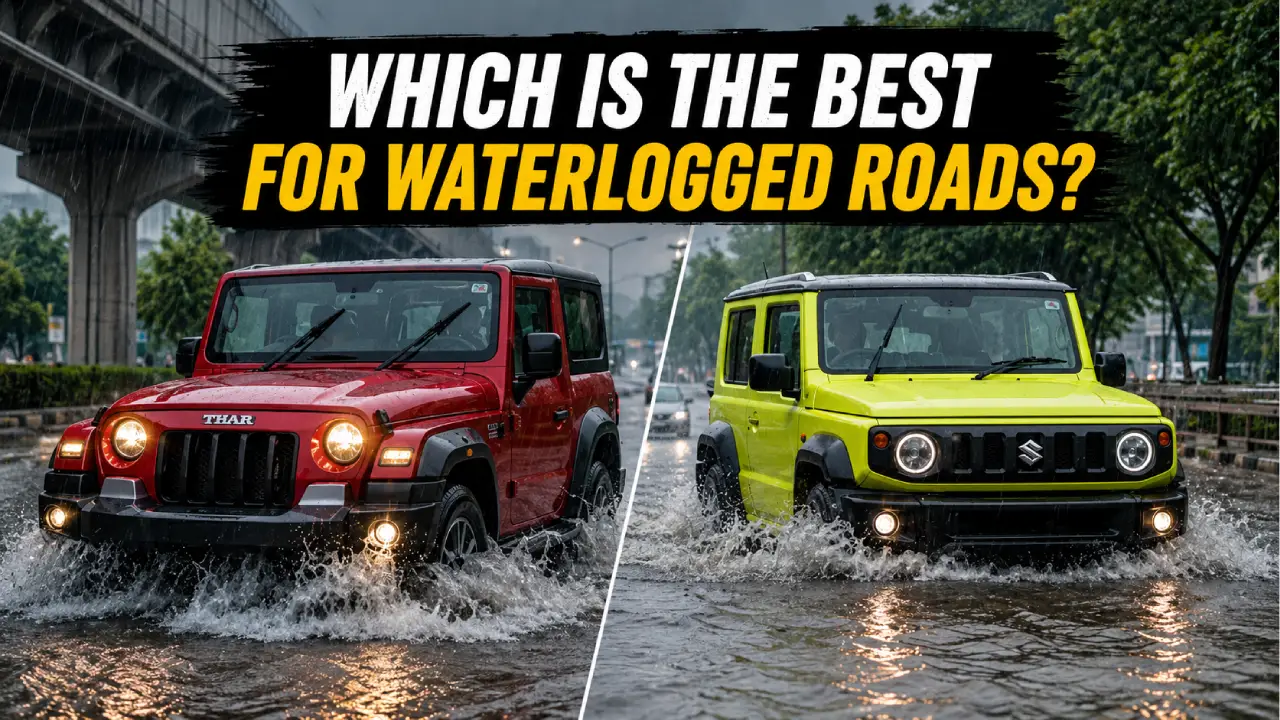
Introduction: Looking for the best SUV to tackle flooded roads this monsoon? Here’s a detailed comparison of the Mahindra Thar and Maruti Jimny, covering safety, off-road capability, prices, and essential driving tips.
Mahindra Thar vs Maruti Jimny: Which SUV Is Better for Monsoon Driving?
Heavy monsoon showers across several Indian cities have once again raised concerns about waterlogged roads. During such conditions, buyers often compare the Mahindra Thar and Maruti Suzuki Jimny, two popular 4×4 SUVs known for their off-road capability. Both models come equipped with dedicated four-wheel-drive systems, making them suitable for rough terrain and slippery roads.
However, driving safely during heavy rainfall depends on much more than just having a 4×4 system. Ground clearance, water wading capability, traction control, and driver awareness all play an equally important role.
Mahindra Thar Water Wading Capacity and Jimny Off-Road Performance
The Mahindra Thar offers a 650mm water wading capacity, making it one of the strongest options for deep-water crossings. Moreover, its 226mm ground clearance and larger wheels help maintain stability over potholes, uneven roads, and muddy tracks.
Meanwhile, the Maruti Jimny has its own strengths. Thanks to its compact dimensions and shorter wheelbase, it feels more agile on narrow city streets and tight village roads. Its low-range transfer case also helps maintain traction while climbing slippery surfaces.
Both SUVs feature Electronic Stability Program (ESP), which improves grip on wet roads and reduces the risk of skidding during sudden steering inputs.
Mahindra Thar vs Maruti Jimny Price Comparison (July 2026)
| City | Mahindra Thar | Maruti Jimny | Estimated EMI |
|---|---|---|---|
| Mumbai | ₹14.10 Lakh | ₹14.85 Lakh | ₹28,000/month |
| Surat | ₹13.40 Lakh | ₹14.10 Lakh | ₹26,000/month |
| Bhubaneswar | ₹13.55 Lakh | ₹14.25 Lakh | ₹27,000/month |
Prices may vary depending on variant, insurance, and dealer offers. Therefore, buyers should confirm the latest on-road pricing before making a purchase.
Monsoon Driving Tips for Thar and Jimny Owners
Even if you own a capable 4×4 SUV, avoid driving through water deeper than the wheel hub. Deep water can enter the engine’s air intake, leading to hydrolock, one of the most expensive engine failures. Repair costs can easily run into several lakhs if water damages internal engine components.
Moreover, buyers should consider adding an Engine Protection Cover to their insurance policy, as standard comprehensive insurance may not always cover hydrolock-related damage.
Keep recovery equipment such as a tow strap, portable air compressor, and emergency flashlight inside the vehicle. Checking weather alerts before starting your journey can also help you avoid flooded routes.
Which SUV Should You Buy?
If your area regularly experiences deep flooding or challenging rural roads, the Mahindra Thar offers better water wading capability and stronger off-road credentials. On the other hand, if you primarily drive in cities with occasional waterlogging, the Maruti Jimny provides easier maneuverability, compact dimensions, and excellent everyday usability.
Ultimately, the safer choice depends on your driving conditions, but responsible driving remains the biggest safety feature regardless of which SUV you choose.
FAQs
Which SUV has better water wading capacity?
The Mahindra Thar offers a water wading capacity of up to 650mm, making it more suitable for deeper water crossings than the Jimny.
Is the Maruti Jimny good for city driving during monsoon?
Yes. The Jimny’s compact size, short wheelbase, and 4×4 system make it easy to drive through narrow streets and moderate waterlogged roads.
Can insurance cover engine damage caused by flood water?
Not always. Most standard policies do not cover hydrolock damage unless you have an Engine Protection Cover included in your insurance.